
Audubon’s The Birds of America remains one of the most significant achievements in both natural history and the world of art. Produced between 1827 and 1838, the collection consists of 435 hand-colored, life-sized prints that captured the avian diversity of a young United States with unprecedented detail.
The scale of the project was massive scope. Audubon insisted on painting every bird life-sized, which led to the creation of his Double Elephant Folio. The format used paper measuring 26 x 39 inches. To fit larger species, like the American Flamingo or the Great Blue Heron—onto the page, Audubon frequently depicted them in dynamic, contorted poses, bending their necks or tucking their wings to maintain a 1:1 scale.
Before Audubon, most ornithological illustrations were stiff and clinical, drawn from stuffed specimens in museums. He spent years in the American wilderness of the early to mid 1800’s observing the behavior, habitats, and movements of his subjects.
Audubon's work has survived nearly two centuries of market fluctuations because of its unique blend of scientific importance and aesthetic drama. In current day, collectors are increasingly focused on quality over quantity, gravitating toward works with impeccable provenance and vivid color preservation.
The market generally breaks down into two categories: museum-grade investment (the large-scale folios) and Accessible Heritage (the smaller Octavo editions).
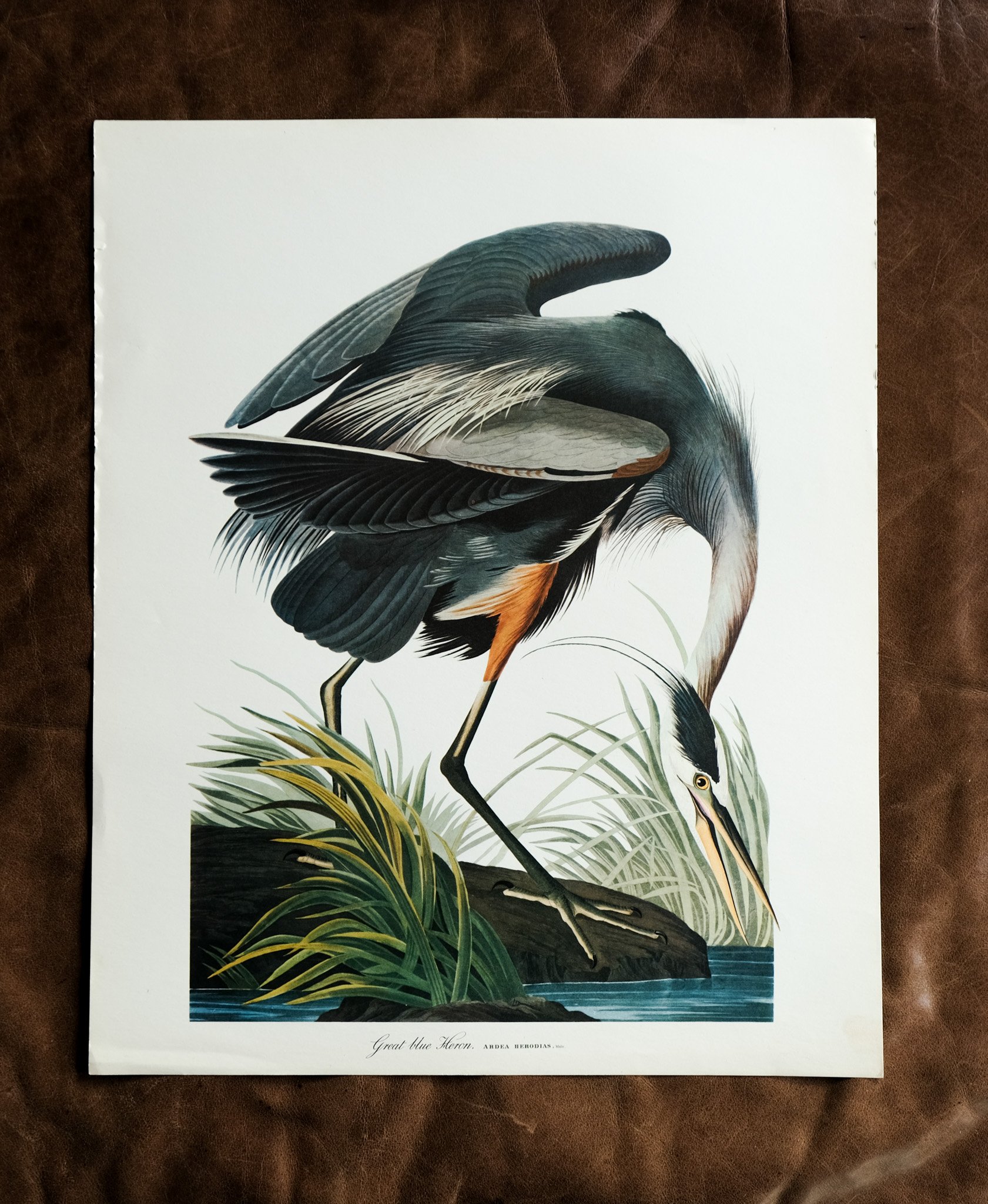
Edition and Folio Hierarchy -
1. The Havell Edition (Double Elephant Folio): This edition is considered to be the holy grail and the gold standard. Only about 200 complete sets were produced. Because many of these sets were broken up over the decades to sell individual plates, finding a "fresh to market" Havell print is a major event in the art world. Prices for prints from this original edition can range from several thousand to over $200,000 for a single sheet.
2. The Bien Edition: This was a rare, mid-19th-century attempt to recreate the work using chromolithography. Fewer than 75 sets were completed, making them technically rarer than the Havell edition, though they often sell for less because they lack the hand-colored watercolor touch.
3. The First Royal Octavo Edition: These were smaller, more affordable prints meant for the 19th-century middle class. Today, they are the entry point for serious collectors, offering a way to own an original "Audubon-supervised" work for a few hundred to a few thousand dollars.